Automatic Polar Alignment
I assume that most of you are capable of performing polar alignment (hereinafter: PA) with an accuracy of one arcsecond, and can complete the process within a minute or less. I, however, seem to be somewhat less adept – my attempts take considerably longer, yield mediocre results, and are generally frustrating. Additionally, I am not particularly fond of freezing my hands during the process.
This led me to the idea of motorizing and automating the PA procedure for my own setup. The design objectives were as follows:
- fully automated PA process in cooperation with the TPPA plugin in N.I.N.A.,
- compatibility with my setup, with potential adaptability to other configurations,
- modification limited to the EQ6 tripod and EQ6 pier extender,
- no modifications to the mount itself,
- 12V power supply,
- control via USB/Bluetooth and configuration over Wi-Fi.
There are already commercial solutions available; however, I found them unsatisfactory either in terms of cost or engineering approach. Therefore, I decided to design my own solution – admittedly quite unconventional.
In this design, control of the ALT axis is achieved by precisely extending or retracting one of the tripod legs. This leg must be oriented approximately toward the north. Positioning in the AZ axis, on the other hand, is accomplished by rotating the pier extender.
In detail, the system is implemented as follows:
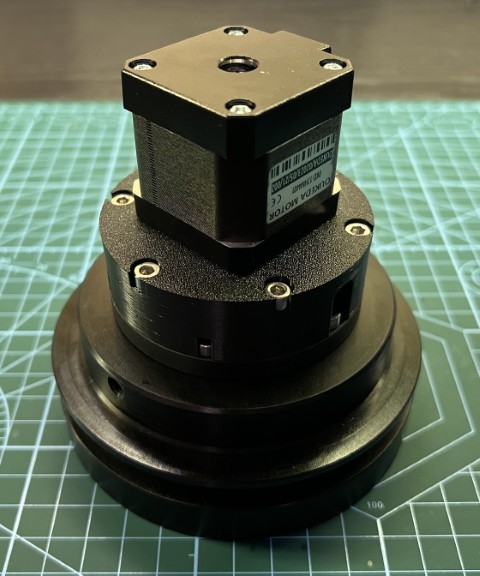
- ALT axis: A custom attachment is mounted on a tripod leg. The attachment houses a stepper motor, a 5:1 belt transmission, and a trapezoidal lead screw (as used in CNC machines). Rotation of the lead screw converts rotary motion into linear motion, allowing controlled extension or retraction of the tripod leg.
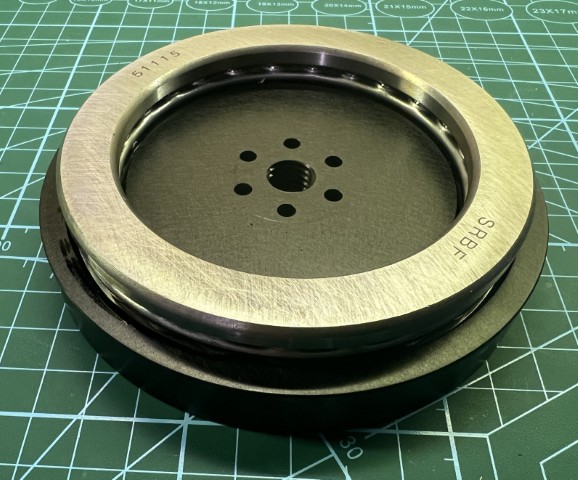
- AZ axis: Two aluminum plates rotate relative to each other. The lower plate is fixed to the tripod, while the upper plate is attached to the pier extender housing. The plates are separated by a large thrust bearing, which supports the full load of the system. Rotation is driven by a stepper motor coupled with a 14:100 harmonic drive.
- Control system: The entire setup is managed by a custom OnStep-based controller board. However, the firmware I developed is independent of OnStep and instead complies with the communication protocol used by the PA plugin in N.I.N.A.
The system enables control of both ALT and AZ axes with a resolution of 1 arcsecond. The AZ axis supports a full 360-degree rotation, while the ALT axis allows adjustments within a range of ±4 degrees. The assembly is capable of handling substantial loads—I have personally tested it by sitting on the tripod, confirming it can withstand at least 80 kg.
In practical use, the system performs exceptionally well: N.I.N.A. executes the PA routine, and after each image acquisition and plate-solving step, it sends correction data to the AutoPA module, which applies the required adjustments automatically. The user can define the target PA accuracy within N.I.N.A. – and the system takes care of the rest. With the target accuracy set to 0.2 arcsec it takes about 4 – 6 iterations to reach the goal.